
Look, I'm not going to sugarcoat it - breaking into NYC finance is brutal. I've watched brilliant friends get rejected from Goldman Sachs while somehow less qualified candidates (myself included, honestly) stumbled into dream internships through sheer luck and knowing the right people. New York City's Financial District is the heart of the global financial world, sure, but it's also where dreams go to die if you don't know how to play the game.
Here's what nobody tells you: Goldman Sachs and JPMorgan only accept 0.8% and 0.9% of students who apply to their internships, respectively. Those odds? Yeah, you're more likely to get struck by lightning. Twice. But here's the thing - people still get these internships, and they're not all superhuman geniuses from Harvard.
Table of Contents
TL;DR
- NYC finance internships require strategic timing - applications open July-August for following summer, with interviews September-November (yes, you read that right)
- Technical skills aren't optional - master Excel modeling, financial statement analysis, and basic programming or you'll crash and burn
- Networking feels awkward but isn't optional - leverage campus events, professional organizations, and yes, cold outreach to people who might ignore you
- Target schools get the red carpet treatment, but non-target students can break in if they're willing to work twice as hard
- Your internship performance directly impacts full-time offers - no pressure, but those 10 weeks basically determine your entire career trajectory
Understanding NYC's Finance Internship Ecosystem
Here's the deal - NYC's finance sector is basically the academic hunger games, but with better suits and higher stakes. The ecosystem spans traditional Wall Street powerhouses that'll work you to death, emerging fintech companies that promise "work-life balance" (spoiler: they're lying), and specialized asset management firms where you might actually see sunlight occasionally.
The reality nobody wants to admit? Success has less to do with raw talent and more to do with understanding how this weird system actually works. I spent my sophomore year thinking applications opened in January like normal internships. Spoiler alert - they don't. I've seen brilliant students miss out completely because they didn't know the recruitment calendar, while well-prepared candidates from random state schools secured Goldman offers through strategic networking and obsessive preparation.

The Powerhouse Sectors Shaping Your Career Path
Okay, real talk - there are basically three ways to sell your soul in NYC finance, and each one will destroy your social life in different ways. Investment banking will make you question your life choices at 3 AM while building pitch decks, asset management will turn you into a market-obsessed zombie who checks Bloomberg at dinner, and fintech will convince you that disrupting traditional finance is worth the inevitable burnout.
Understanding these differences isn't just academic - it's survival. Each sector attracts different personality types (Type A psychopaths, analytical introverts, and tech bros with finance degrees, respectively) and rewards different skill sets. Choose wrong, and you'll spend your summer counting down the days until you can escape.
|
Sector |
Work Hours |
Key Skills |
Typical Compensation |
Full-Time Conversion Rate |
|---|---|---|---|---|
|
Investment Banking |
80-100+ hours/week |
Financial modeling, Excel mastery, Deal execution |
$85,000-$150,000 |
85-95% |
|
Asset Management |
50-70 hours/week |
Research, Portfolio analysis, Client relations |
$70,000-$120,000 |
70-85% |
|
Fintech |
45-65 hours/week |
Programming, Data analysis, Product development |
$75,000-$130,000 |
60-80% |
Investment Banking: Where Legends Are Made (and Sleep Is Lost)
Investment banking internships are basically boot camps that transform college students into deal-making machines who survive on caffeine and pure adrenaline. These aren't just internships - they're 10-week tests of how much psychological torture you can endure while maintaining a professional facade.
Goldman Sachs, JP Morgan, and Morgan Stanley run the most prestigious programs, and honestly? They know it. You'll work 80+ hour weeks, but you'll also gain exposure to billion-dollar transactions that most professionals never see. The training programs are legendary - Goldman's 10-week curriculum covers everything from DCF modeling to industry-specific knowledge that would take years to learn elsewhere.
Here's what they don't tell you in the recruitment presentations: you're not fetching coffee, but you're also not sleeping. You'll build pitch books until your eyes bleed, conduct due diligence on companies you've never heard of, and participate in client calls where one wrong number could tank a deal. The learning curve isn't steep - it's vertical.
What separates successful IB interns from the casualties? They arrive with solid Excel skills (and I mean solid - not "I can make a pie chart" solid), understand basic valuation methods, and most importantly, can handle feedback without taking it personally. The culture rewards people who ask smart questions and volunteer for additional work, even when they're already drowning.
Taylor Elliott '26's Goldman Sachs Experience: San Francisco native Taylor Elliott secured an internship with Goldman Sachs in structured finance, rotating through sustainable banking and consumer pods. She emphasized that while the work was demanding, "the people I worked with were what really made the experience. I now think I have a good idea of what it will be like post-graduation, and I'm looking forward to it." Translation: the people were nice enough that she's willing to sacrifice her twenties for this career.
Asset Management: The Thinking Person's Finance Career
Asset management is where finance nerds go to feel intellectually superior while still making obscene amounts of money. Internships at BlackRock, Vanguard, and boutique private equity shops emphasize analytical rigor and long-term thinking, which is code for "we'll still work you hard, but you might actually understand why."
BlackRock's internship program focuses heavily on research and portfolio construction. You'll spend time analyzing market trends, building financial models that actually make sense, and presenting investment recommendations to senior portfolio managers who will tear apart your logic with surgical precision. The work is intellectually stimulating without the brutal hours of investment banking, which means you might occasionally remember what your friends look like.
Private equity internships are the holy grail - harder to land than a date with your celebrity crush, but offering incredible learning opportunities. You'll participate in deal sourcing, conduct management interviews, and help monitor portfolio companies. These roles require strong analytical skills and the ability to think like an owner, not just an advisor who bills by the hour.
The key differentiator for asset management success? Genuine curiosity about markets and companies, not just the money they can make you. Successful interns read the Wall Street Journal religiously, follow earnings calls like sports fans follow games, and can articulate investment theses without sounding like they memorized a textbook.

Fintech: Where Finance Meets the Future (and Pretends It's Different)
Fintech internships are where traditional finance knowledge meets Silicon Valley delusions of grandeur. Companies like Stripe, Robinhood, and various cryptocurrency firms promise more creative freedom and faster decision-making, which usually translates to "we don't know what we're doing either, but at least we have better snacks."
Stripe's finance internship program combines traditional FP&A work with product analytics and growth modeling. You're not just crunching numbers; you're helping shape how millions of businesses process payments while pretending that calling it "fintech" makes the spreadsheets more exciting. The pace is fast, the problems are novel, and the impact is immediate - assuming the company doesn't pivot three times during your internship.
Robinhood offers internships across trading operations, risk management, and product finance. You'll work on "democratizing finance" (their words, not mine) while learning about market microstructure and regulatory compliance. It's finance with a Silicon Valley twist, which means casual Fridays and unlimited PTO that nobody actually takes.
Crypto firms present the wildest opportunities and the highest chance of existential crisis. You might work on tokenomics (yes, that's a real word), DeFi protocols, or institutional custody solutions. The space is volatile, regulatory uncertainty is sky-high, but the learning opportunities are unmatched if you're interested in watching the future of finance get built in real-time.
Cracking the Recruitment Timeline Code
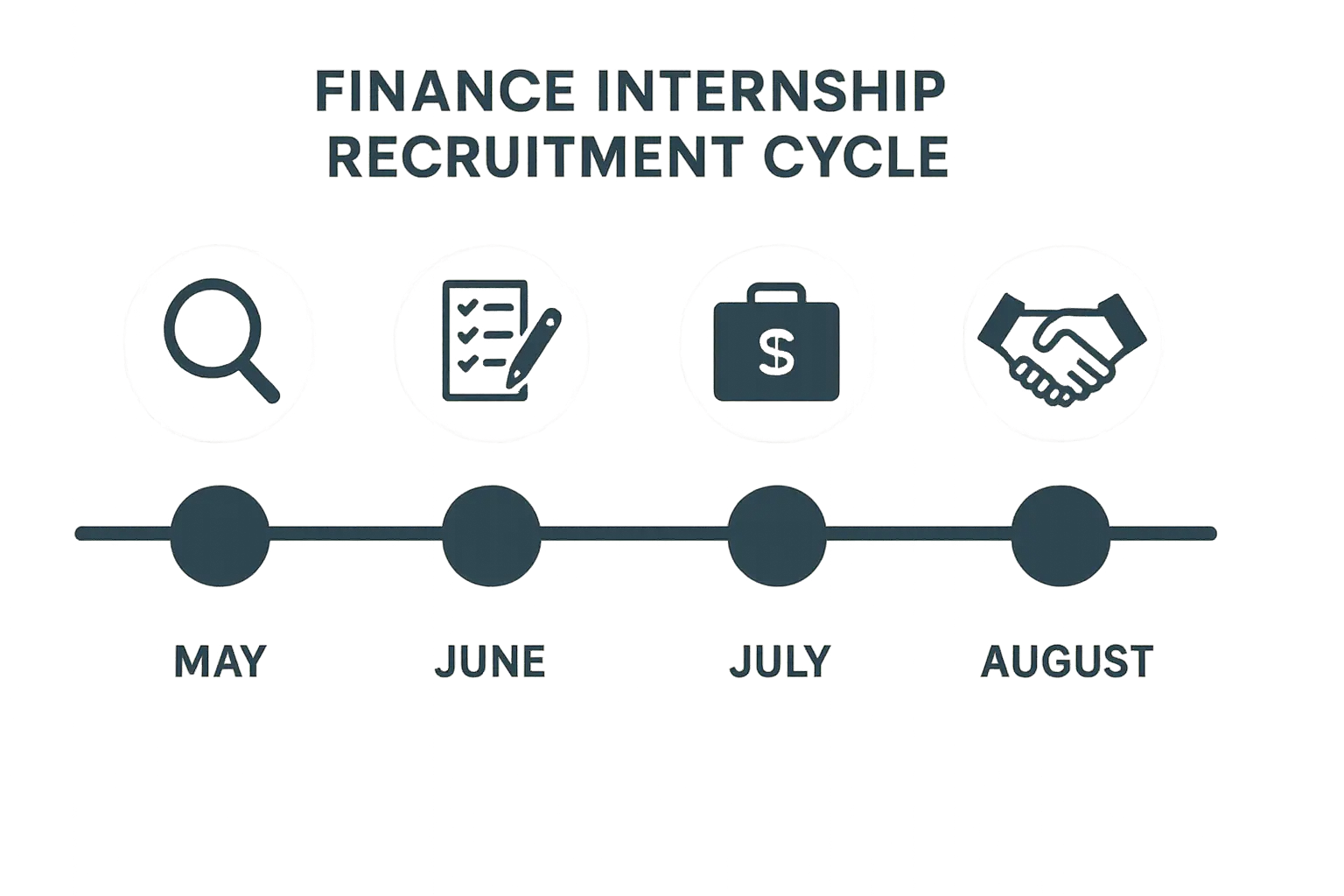
Here's where things get really stupid: finance internship recruitment follows timelines that make absolutely no sense to normal humans. Traditional investment banking operates on a schedule that seems designed by sadists - applications open in July for the following summer, which means you're thinking about next year's internship while your friends are still figuring out their summer plans.
I cannot stress this enough - missing these deadlines isn't just unfortunate, it's career suicide. I've watched brilliant students get shut out completely because they thought they had until spring to figure things out. This process rewards early preparation and punishes procrastination with the ruthlessness of a medieval torture device.
Application Timing Checklist:
- June: Begin researching target firms and updating resume (while crying internally)
- July: Submit applications as soon as they open (literally the same day if possible)
- August: Prepare for networking events and practice not looking desperate
- September: Attend campus recruiting events and first-round interviews
- October-November: Complete final-round interviews and superdays (aka judgment day)
- December: Receive offers and make life-altering decisions within one week
The Summer Analyst Sprint: Your Make-or-Break Timeline
Summer analyst programs follow a timeline so compressed it makes your head spin. Applications open in July-August for the following summer - yes, thirteen months in advance. This isn't just early planning; it's academic time travel. While you're enjoying summer break, next year's interns are already submitting applications and having existential crises about their career choices.
Most investment banking jobs are "converted" from summer internships, with students completing a summer internship after their second year and receiving full-time offers if they don't completely embarrass themselves. "Some banks, such as Morgan Stanley, recruit exclusively from their summer internships" according to eFinancial Careers, making these 10-week programs absolutely crucial for your entire career trajectory. No pressure.
The interview process runs from September through November, which means you're juggling recruiting with actual schoolwork like some kind of masochistic multitasking champion. First rounds typically happen on campus (if you're lucky enough to attend a target school) or via video call where your WiFi will inevitably cut out during the most important question.
Offers come out in December with most firms expecting decisions within a week. This creates a delightfully stressful situation where you're choosing your entire career path based on limited information and whatever LinkedIn stalking you managed to do. The key is researching firms thoroughly during the application process, not after you receive offers and panic.
Pro tip from someone who learned this the hard way: Create a recruitment calendar in June and treat it like your religion. Mark application deadlines, information session dates, and interview periods. This process moves faster than a New York minute, and organization separates successful candidates from those who miss opportunities due to poor planning and general life chaos.
Off-Cycle Opportunities: The Hidden Pathway for the Rest of Us
Off-cycle and spring internships are like the finance world's best-kept secret - alternative entry points for students who missed traditional recruiting or want to explore different sectors without committing their entire soul. These opportunities often have less competition and more flexible requirements, making them perfect for building experience and proving you're not completely hopeless.
Spring internships run January through May and often convert to summer positions if you don't screw them up too badly. Boutique investment banks, asset managers, and fintech companies frequently hire for these roles. The application process is less structured but also less predictable, which means more opportunities for regular humans to sneak in through the back door.
Off-cycle opportunities pop up throughout the year when firms have unexpected needs or want to evaluate candidates outside the traditional cattle call. These roles might last 3-6 months and often lead to full-time offers for exceptional performers who prove they can handle the work without constant supervision.
The advantage of off-cycle recruiting? Less competition and more personalized attention during the interview process. Firms are solving specific problems rather than filling predetermined slots, which means they're more flexible about backgrounds and experiences. It's your chance to be a person, not just another resume in a pile of identical overachievers.
Building Your Network Before You Need It
Let me be brutally honest about networking in NYC finance: it's awkward as hell, feels incredibly fake, and is absolutely essential for your career survival. Recent success stories prove this point - "Washington and Lee University students" consistently secure internships at prestigious firms like Goldman Sachs, Citibank, and Wells Fargo by leveraging their alumni network like it's their job.
Here's what nobody tells you about networking: it's basically professional speed dating where everyone's trying to figure out if you're worth their time while you're doing the same thing back. One student noted, "If I had to guess, I'd say there are probably at least 20 different people in the part of the bank that I was working in who were W&L alumni. Everybody I reached out to would always immediately get back to me and be super happy to chat." Translation: alumni connections are basically cheat codes for breaking into finance.
Campus Recruitment: Your First Competitive Advantage (If You're Lucky)
Target schools (Harvard, Wharton, Columbia, etc.) get the red-carpet treatment that would make celebrities jealous. Firms send senior bankers for information sessions, host exclusive dinners with actual good food, and conduct first-round interviews on campus. If you attend one of these schools, congratulations - you've won the geographic lottery. Take advantage of every single opportunity because your classmates certainly will.
Non-target students face bigger challenges but aren't completely screwed. Many firms host virtual information sessions open to all students, probably because their lawyers told them they had to. Attend these religiously, ask thoughtful questions that show you've done your homework, and follow up with recruiters afterward. Your goal is to stand out among hundreds of participants who are all desperately trying to seem impressive.
Alumni networks are your secret weapon, especially if you're not at a target school. Search LinkedIn for graduates working at target firms and request informational interviews. Most professionals remember their own struggles breaking into finance and are surprisingly willing to help promising students, probably because it makes them feel important and wise.
Professional Organizations: Your Networking Multiplier
The CFA Institute hosts regular events in NYC covering everything from portfolio management to fintech innovations. Attend these sessions to learn about industry trends while meeting professionals from different firms. Student memberships are affordable and provide access to valuable resources that will make you sound smarter in interviews.
Women in Finance offers mentorship programs, networking events, and career development workshops. Even if you're not the target demographic, many events are open to allies and provide insights into diversity initiatives at major firms, which is increasingly important interview fodder.
Industry-specific groups like the Fixed Income Analysts Society or Private Equity Women focus on particular sectors. These smaller communities offer more intimate networking opportunities and deeper technical discussions, plus you're less likely to get lost in a crowd of desperate students.
Cold Outreach: The Art of Professional Begging
LinkedIn is your primary outreach tool, but most students use it completely wrong. Don't send generic connection requests asking for internships - that's the professional equivalent of sliding into someone's DMs asking for nudes. Instead, reference specific deals they worked on, articles they've written, or presentations they've given. Show that you've done your homework and aren't just mass-messaging everyone with "Goldman Sachs" in their profile.
Informational interviews are gold mines when approached correctly, but they're also opportunities to completely embarrass yourself. Ask about their career path, daily responsibilities, and industry outlook. Avoid asking directly about internship opportunities during the first conversation - your goal is building a relationship, not making an immediate ask that screams desperation.
Coffee chats work best when you're already in NYC and can offer to meet near their office at their convenience. Come prepared with thoughtful questions, be respectful of their time, and don't order the most expensive thing on the menu. A 20-minute conversation can lead to referrals, interview tips, or future opportunities if you don't completely blow it.
Follow-up is crucial but often overlooked by students who think the hard work is over after the initial meeting. Send thank-you notes within 24 hours, share relevant articles you discussed, and provide updates on your job search progress. Consistent, valuable communication keeps you top-of-mind when opportunities arise.
Strategic Networking Success: Atiba de Souza '26 from Washington, D.C., who interned at Lincoln International, approached networking like a military operation: "a spreadsheet of the top 30 or 40 banks and found two or three W&L contacts from each one, and I just contacted each person." This systematic approach led to valuable connections and ultimately helped him secure his internship. The lesson? Treat networking like a part-time job, because that's essentially what it is.
Building Your Competitive Edge From Scratch
Creating a standout profile for NYC finance internships is like trying to win a bodybuilding competition when everyone else has been lifting weights since they were twelve. You're not just competing against other students - you're competing against legacy admits whose parents work at the firms, international students who speak four languages fluently, and that one kid from your econ class who somehow already has three internships on their resume.
The brutal truth? You need to be exceptional at multiple things simultaneously while making it look effortless. Good grades aren't enough, relevant experience isn't enough, and even perfect interview skills aren't enough on their own. You need the whole package, and you need it yesterday.

Essential Skills That Actually Matter
Okay, real talk - these firms are looking for people who won't completely fall apart when someone screams at them about a typo in a pitch deck at 2 AM. Yeah, you need the technical stuff, but honestly? Half of it is just proving you can handle the chaos without having a breakdown in the bathroom.
Technical Skills Priority Checklist:
- Advanced Excel proficiency (and I mean ADVANCED - not "I can make a pivot table")
- Financial statement analysis that goes deeper than basic ratios
- Basic programming skills because it's 2024, not 1994
- Bloomberg Terminal certification (it's free and shows you're serious)
- Valuation methods that you can explain while sleep-deprived
- Understanding of accounting that won't embarrass you in interviews
Technical Proficiency: Your Foundation for Success
I cannot stress this enough - if you can't build a three-statement model without Googling formulas every five minutes, you're going to have a bad time. I learned this the hard way when I confidently told my interviewer I was "advanced" at Excel, then proceeded to struggle with a basic VLOOKUP during my case study. Embarrassing doesn't begin to cover it.
Excel mastery isn't optional - it's your entry ticket to not being immediately dismissed as incompetent. You need to build three-statement models, perform sensitivity analyses, and create dynamic charts without breaking a sweat. Most students think they know Excel because they can make a pie chart, but finance-level proficiency means using keyboard shortcuts exclusively and building error-proof formulas that won't crash when someone changes an input.
Financial statement analysis goes way beyond calculating some ratios and calling it a day. You should understand how different accounting treatments affect reported earnings, identify red flags in cash flow statements that suggest management is playing games, and explain how business model changes impact financial metrics. Practice with real 10-K filings from actual companies, not sanitized textbook examples that bear no resemblance to reality.
Programming skills increasingly separate strong candidates from exceptional ones, whether you like it or not. Python helps with data analysis and automation, while R is valuable for statistical modeling and research. You don't need to be the next Mark Zuckerberg, but basic proficiency shows you can adapt to evolving industry tools without needing your hand held.
Bloomberg Terminal certification (BMC) is free and demonstrates you're serious about financial markets rather than just chasing prestige and money. The four-hour course covers market data, news analysis, and basic functions that professionals use daily. It's not required, but it shows initiative and familiarity with industry-standard tools that separates you from students who think Yahoo Finance is sophisticated.
Government finance internships in NYC offer structured learning opportunities for students who need to build experience gradually. Positions like the Administration for Children's Services Financial Data Intern offer "$19.00 per hour" while providing hands-on experience with financial processes, report auditing, and database management - valuable stepping stones that won't completely destroy your social life.
Academic Excellence: More Than Just GPA (But GPA Still Matters A Lot)
Let's talk about the GPA elephant in the room. If you're sitting there with a 3.2 thinking you can charm your way into Goldman, I hate to break it to you, but their computer system will reject your application before a human even sees it. Is it fair? Absolutely not. Is it reality? Unfortunately, yes. But before you panic - there are workarounds.
GPA thresholds are real and non-negotiable at top firms. Goldman Sachs and JP Morgan typically require 3.7+ GPAs, while smaller firms might accept 3.5+ if you have exceptional experience or connections. If your GPA is below these thresholds, you need to compensate with incredible internships, stellar networking, or some combination of both.
Course selection matters more than most students realize because recruiters actually look at your transcript. Corporate finance, intermediate accounting, and statistics are essential foundations that show you understand the basics. Advanced courses like derivatives, fixed income, or private equity demonstrate specialized interest and technical depth.
Quantitative skills are becoming increasingly important across all finance sectors, whether you're interested in traditional banking or trendy fintech. Take econometrics, data analysis, or programming courses to build analytical capabilities. Many firms now include coding challenges or data interpretation exercises in their interview processes, and you don't want to be caught off-guard.
Study abroad programs can differentiate your profile if you choose strategically. London School of Economics, HEC Paris, or Hong Kong University programs show global perspective and adaptability while providing networking opportunities with international students who might become valuable connections later.
Experience Building That Opens Doors
Here's something career services won't tell you - your first finance internship doesn't need to be at Goldman Sachs. In fact, it probably won't be, and that's completely fine. The key is showing continuous progression and learning from each experience rather than just collecting random internships that don't build toward anything coherent.
Stepping Stone Strategy: Building Your Path to Wall Street
Regional banks, boutique investment firms, and corporate finance roles at Fortune 500 companies provide valuable experience and often lead to better opportunities down the road. The key is demonstrating progression and extracting maximum learning from each experience, even if the prestige factor isn't immediately obvious.
Boutique investment banks offer incredible learning opportunities with more hands-on experience than bulge bracket firms where you might spend months formatting PowerPoint slides. You might work directly with managing directors, participate in client meetings, and gain exposure to the entire deal process. These experiences create compelling interview stories for larger firms because you can speak intelligently about actual deals.
Corporate finance internships at non-financial companies teach business fundamentals while building technical skills that transfer everywhere. You'll work on budgeting, forecasting, and capital allocation decisions that directly impact business operations. This experience shows you understand how finance supports broader business objectives rather than just existing in a vacuum.
Wealth management internships provide client-facing experience and insight into investment management that many students overlook. While not as prestigious as investment banking, these roles teach relationship building, portfolio construction, and market analysis skills that transfer to other finance careers and make you more well-rounded.
Finance internship programs typically last 8-18 weeks, with "non-US citizens can intern for up to a maximum duration of 12 weeks. US citizens may intern up to a maximum duration of 18 weeks" according to InternHQ, providing substantial time to develop skills and build relationships that can lead to full-time opportunities if you don't completely mess them up.
Personal Projects: Demonstrating Initiative and Passion
Stock pitch competitions are excellent resume builders and learning opportunities that show you can think like an investor rather than just memorize formulas. Events like the CFA Institute Research Challenge require teams to analyze public companies and present investment recommendations to industry professionals. Winning isn't necessary - participation shows initiative, teamwork skills, and the ability to handle pressure.
Personal investment portfolios demonstrate genuine interest in markets, even if you're only investing your coffee money. Track your investment thesis, document your research process, and be prepared to discuss both successful and unsuccessful investments. This shows you're willing to put your money where your mouth is rather than just talking about theoretical concepts.
Financial modeling projects using real company data showcase technical skills and analytical thinking in ways that classroom assignments never will. Build a DCF model for a company you're interested in, create a merger analysis, or develop a trading strategy backtest. Post these projects on GitHub or personal websites to demonstrate your capabilities to potential employers.
Relevant certifications like Bloomberg Market Concepts, Financial Modeling & Valuation Analyst (FMVA), or CFA Level 1 show commitment to professional development beyond just showing up to class. These credentials aren't required but demonstrate serious interest in building finance expertise rather than just chasing prestige.
Industry research projects where you analyze sector trends, regulatory changes, or market disruptions show intellectual curiosity and business acumen that goes beyond textbook learning. Write thoughtful analyses and publish them on LinkedIn or Medium to build your professional brand and demonstrate thought leadership potential.

Mastering the Application and Interview Gauntlet
Successfully navigating the finance recruitment process is like running an obstacle course designed by people who hate you personally. The process tests not only your knowledge and skills but also your ability to perform under extreme pressure while maintaining the perfect balance of confidence and humility that somehow demonstrates you'll thrive in their particular brand of organized chaos.
Application Materials That Cut Through the Noise
Your resume, cover letter, and online presence need to work together to tell a story that makes recruiters think, "We need to meet this person immediately" rather than "Great, another cookie-cutter finance wannabe." The challenge? Everyone else is trying to do exactly the same thing with roughly the same experiences and qualifications.
Resume Optimization: Your 30-Second Sales Pitch
Finance resumes are one-page documents with zero tolerance for errors, typos, or creative formatting that shows your "personality." Use a clean, professional format with consistent spacing, bullet points, and font choices that won't make recruiters question your judgment. They see hundreds of resumes daily - yours needs to be scannable and error-free to survive the first brutal cut.
Action verbs matter more than you think because passive language makes you sound like you just existed at your previous jobs rather than actually accomplishing anything. Start bullet points with "Analyzed," "Developed," "Managed," or "Led" rather than "Responsible for" or "Helped with." Quantify everything possible: "Analyzed financial statements for 15 companies" is infinitely better than "Analyzed financial statements."
Technical skills deserve their own prominent section because that's often what recruiters scan for first. List programming languages, software proficiency, and certifications that are actually relevant to finance. Include your Bloomberg Terminal certification, advanced Excel skills, and any programming languages you've learned, but don't lie about your proficiency level.
Education section should include GPA (if above 3.5), relevant coursework that shows you understand finance basics, and academic honors that demonstrate consistent excellence. Study abroad programs, dean's list recognition, and finance-related projects belong here too, but don't include your high school information unless you want to look like you peaked at eighteen.
Work experience doesn't need to be finance-related, but you should emphasize transferable skills that show you can handle responsibility and work with people. Retail jobs can highlight customer service and multitasking abilities under pressure. Research positions demonstrate analytical skills and attention to detail that directly transfer to finance work.
|
Resume Section |
Key Elements |
Common Mistakes to Avoid |
|---|---|---|
|
Header |
Name, phone, email, LinkedIn profile |
Unprofessional email addresses, missing LinkedIn |
|
Education |
GPA (if >3.5), relevant coursework, honors |
Including high school info, listing irrelevant courses |
|
Experience |
Quantified achievements, action verbs, transferable skills |
Passive language, duties instead of accomplishments |
|
Skills |
Technical proficiencies, certifications, languages |
Listing basic software as "advanced," outdated skills |
|
Activities |
Leadership roles, finance-related involvement |
Including every activity, lack of leadership examples |
Cover Letters That Actually Get Read
Most cover letters are terrible - generic, boring, and obviously mass-produced templates that make recruiters want to delete your application immediately. Yours needs to stand out by showing genuine research and specific interest in the firm rather than sounding like you're applying to every bank on Wall Street with the same letter.
The opening paragraph should grab attention immediately rather than starting with some variation of "I am writing to express my interest in..." Reference a specific conversation with an employee, a recent news article about the firm, or a particular aspect of their business that genuinely interests you. Avoid generic openings about your lifelong passion for finance that sound like everyone else's.
Connect your experiences to their specific needs explicitly rather than making recruiters figure out why you're qualified. If they emphasize teamwork, describe a specific project where you collaborated effectively under pressure. If they value analytical thinking, explain how you've used data to solve problems or make decisions that had real impact.
Keep it concise - three paragraphs maximum because recruiters don't have time for your life story. Make every sentence count and avoid repeating information that's already on your resume. The cover letter should add context and personality, not just restate your qualifications in paragraph
Keep it concise - three paragraphs maximum because recruiters don't have time for your life story. Make every sentence count and avoid repeating information that's already on your resume. The cover letter should add context and personality, not just restate your qualifications in paragraph form.
Close with a specific call to action that shows initiative. Request an informational interview, express interest in upcoming recruiting events, or mention your availability for interviews during specific timeframes. Show enthusiasm without sounding desperate or entitled to their attention.
Professional Online Presence: Your Digital First Impression
LinkedIn is your professional homepage, so optimize it completely rather than treating it like Facebook for business people. Use a professional headshot that doesn't look like a selfie, write a compelling headline that goes beyond "Student at [University]," and craft a summary that tells your career story concisely while showing some personality.
Connect strategically with classmates, professors, and industry professionals you've met through networking events or informational interviews. Quality matters more than quantity - focus on building genuine relationships rather than collecting connections like Pokemon cards. Engage meaningfully with their content rather than just hitting the like button.
Share relevant content regularly to demonstrate industry interest and knowledge beyond what you learned in class. Comment thoughtfully on posts from finance professionals, share articles about market trends with your own insights, and write occasional posts about your learning experiences or industry observations that show you're thinking critically.
Clean up your social media presence completely because employers will Google you and check your accounts. Remove or hide anything that doesn't reflect the professionalism expected in finance careers. That includes photos from college parties, controversial political opinions, and anything that might make recruiters question your judgment.
Consider creating a personal website or portfolio showcasing your projects, writing samples, and professional accomplishments. This isn't required but can differentiate you from other candidates, especially for fintech or more innovative firms that value creativity and initiative.

Interview Preparation: Where Careers Are Made or Broken
Interview success requires mastering both technical knowledge and behavioral responses while demonstrating the confidence and poise expected in high-stakes finance environments. The challenge? You need to seem knowledgeable without being arrogant, confident without being cocky, and passionate without being desperate. It's basically professional acting, and the stakes couldn't be higher.
Technical Interview Mastery: Proving Your Competence
Valuation questions are interview staples that separate students who actually understand finance from those who just memorized formulas for tests. You need to explain DCF methodology, comparable company analysis, and precedent transaction analysis clearly and confidently, including key assumptions and limitations that show you understand the real-world applications.
Market knowledge questions test whether you actually follow financial news or just claim to be interested in finance for career purposes. Read the Wall Street Journal, Financial Times, and industry publications daily rather than cramming the night before interviews. Be prepared to discuss recent IPOs, M&A activity, and market volatility with specific examples and informed opinions that demonstrate genuine engagement.
Case study questions require you to analyze business situations and make recommendations under time pressure while someone judges your every move. Practice with consulting-style cases adapted for finance roles, focusing on structured thinking, clear communication, and logical reasoning rather than finding the "perfect" answer that probably doesn't exist anyway.
Accounting questions often trip up otherwise strong candidates who thought they could coast by with basic knowledge. Review fundamental concepts like working capital, depreciation methods, and cash flow statement construction until you can explain them while sleep-deprived. Be able to discuss how different accounting treatments affect financial statements and valuation metrics.
Industry-specific knowledge becomes crucial for specialized roles where generic finance knowledge isn't enough. If you're interviewing for healthcare investment banking, understand industry dynamics, regulatory environment, and key valuation metrics that show you've done your homework rather than just applying randomly.
Technical Interview Success Story: Preston Larmore '26, who interned with Houlihan Lokey's Industrials Group, credits thorough preparation for his success: "They helped me refine my technical and behavioral interview skills through mock interviews. I also relied on them for résumé and cover letter reviews, and they provided networking guidance that helped me connect with alumni at Houlihan Lokey." His responsibilities included building financial models, preparing client presentations, and conducting industry research - all skills he had to demonstrate convincingly during technical interviews.
Behavioral Interview Excellence: Showing Who You Are
The STAR method (Situation, Task, Action, Result) structures your responses effectively, but here's what they don't tell you - if you sound like a robot reciting pre-programmed answers, you've already lost. Practice this format until it becomes natural, but maintain enough spontaneity that you seem like an actual human being rather than a LinkedIn post come to life.
Leadership stories should demonstrate initiative and decision-making without making you sound like a megalomaniac who thinks they're the next Warren Buffett. Examples might include leading a group project where everyone else was slacking, organizing an event that people actually attended, or taking charge during a crisis. Focus on your specific contributions and the measurable impact you created, not just that you were "in charge."
Teamwork examples are crucial since finance careers require extensive collaboration with people who might be smarter, more experienced, or more connected than you. Describe situations where you worked effectively with diverse groups, resolved conflicts without creating enemies, or contributed meaningfully to team success. Show that you can be both a leader and a follower when the situation demands it.
Failure stories are often the most revealing and the hardest to fake. Prepare examples of setbacks, mistakes, or disappointments that taught you valuable lessons about yourself or your approach to challenges. Show self-awareness, accountability, and growth mindset without dwelling on the failure or making excuses that suggest you haven't actually learned anything.
Cultural fit questions assess whether you'll thrive in their specific environment or become another casualty of their demanding culture. Research the firm's values, recent initiatives, and working style thoroughly. Prepare examples that demonstrate alignment with their priorities while showing you understand what you're signing up for.
STAR Method Interview Prep Checklist:
- Prepare 5-7 leadership examples that don't make you sound delusional
- Practice 3-4 teamwork scenarios with specific, measurable outcomes
- Develop 2-3 failure stories that show genuine growth and self-awareness
- Research firm-specific culture and values beyond their marketing materials
- Practice responses out loud to avoid sounding like you're reading a script
Final Round and Superday Success: The Ultimate Test
Superdays are basically academic hunger games where you'll spend 6-8 hours trying to impress people while slowly losing your sanity. You'll face 4-6 interviews with different team members, from analysts who remember being in your position to managing directors who've forgotten what it's like to be human. Each interviewer has different priorities and perspectives, so you need to adapt your approach while maintaining consistency in your core messages.
Energy management becomes crucial during these marathon interview sessions because mental fatigue shows immediately and can derail an otherwise successful day. Eat a substantial breakfast, bring protein bars if allowed, and stay hydrated without drinking so much water that you're constantly asking for bathroom breaks. Maintain enthusiasm and engagement even during your final interview when you feel like your brain is melting.
Take notes between interviews about key points discussed, names mentioned, and follow-up questions you want to ask. This shows attention to detail and genuine interest in the conversations rather than just going through the motions. Plus, it helps you avoid accidentally repeating the same stories to different interviewers.
Prepare different versions of your key stories for different audiences because what resonates with a recent graduate won't necessarily impress a senior managing director. Senior professionals might be more interested in strategic thinking and leadership potential, while junior team members might focus on technical skills and whether you'll fit in with the team culture.
Ask thoughtful questions that demonstrate research and genuine interest rather than questions that could be answered by spending five minutes on their website. Focus on current challenges, team dynamics, recent developments in their business, or industry trends that show you're thinking beyond just landing the internship.
Follow up within 24 hours with personalized thank-you notes to each interviewer that reference specific points from your conversations. This final touch can differentiate you from other strong candidates who either don't follow up or send generic messages that could have been written by ChatGPT.

Turning Your Internship Into a Career Launchpad
Here's something career services won't tell you - your first week as a finance intern, you'll probably feel like you're drowning while everyone around you seems impossibly smart and put-together. You'll find yourself Googling "what is EBITDA" in the bathroom while pretending you totally understand the conversation happening around you. This is completely normal, and the key is asking questions without looking completely helpless.
Maximizing your internship experience requires strategic approaches to performance, learning, and relationship building that go way beyond just showing up and doing whatever they tell you. Excellence demands exceeding expectations on assigned work while proactively seeking additional responsibilities and building internal networks that will actually remember you exist after you leave.
Performance Excellence: Standing Out Among High Achievers
Delivering exceptional work quality when you're surrounded by people who've been doing this longer than you've been thinking about it requires mastering the fundamentals while continuously seeking feedback and improvement opportunities. Success in NYC's fast-paced finance environment demands attention to detail, ownership mentality, and the ability to handle multiple priorities without having a nervous breakdown.
Delivering Work That Exceeds Expectations
Accuracy is absolutely non-negotiable in finance because errors in financial models or presentations can have serious consequences and will immediately destroy any credibility you've built. Double-check every number, formula, and formatting detail before submitting work, even if it means staying later than everyone else. Build checking processes into your workflow rather than relying on panicked last-minute reviews when you're already exhausted.
Meet deadlines consistently, but aim to deliver early when possible because finance moves at a pace that makes normal business seem leisurely. Your work often feeds into larger projects with tight timelines, and being the bottleneck is a career-limiting move. Communicate proactively if you encounter obstacles or need additional time - surprises are infinitely worse than delays when handled professionally.
Ask clarifying questions upfront rather than making assumptions that might send you down completely wrong paths. Understanding the purpose, audience, and key priorities for each assignment helps you deliver exactly what's needed rather than what you think they want. Senior professionals appreciate interns who think strategically about requests rather than just blindly executing tasks.
Seek feedback actively and implement it immediately rather than waiting for formal reviews that might come too late to matter. Don't wait for people to volunteer criticism - ask for input on drafts, request suggestions for improvement, and show that you're committed to continuous learning rather than just getting by.
Take initiative on process improvements and additional value-add activities when you've mastered your core responsibilities. If you notice inefficiencies or opportunities to enhance deliverables, propose solutions respectfully rather than just complaining about how things are done. Interns who contribute beyond their assigned tasks often receive the strongest recommendations and job offers.
Internship Excellence Checklist:
- Triple-check all work for accuracy before submission (seriously, triple-check)
- Deliver assignments early when possible to show reliability
- Ask clarifying questions at project start to avoid confusion later
- Seek regular feedback and implement suggestions immediately
- Volunteer for additional projects that showcase your capabilities
- Maintain professional communication even when you're stressed or tired
Building Internal Networks That Last
Build relationships across all levels, not just with senior professionals who might seem most important for your career. Analysts and associates often have the most direct input on intern evaluations and can provide valuable career advice based on recent experiences. They also remember what it's like to be completely lost and overwhelmed, which makes them more sympathetic to your situation.
Grab coffee or lunch with team members when possible because these informal conversations provide insights into company culture, career paths, and industry trends that you'll never get from formal presentations or training sessions. Show genuine interest in their experiences and perspectives rather than just treating them as networking opportunities.
Participate in optional social events and team activities even when you're exhausted and would rather go home to collapse. After-work drinks, team dinners, and company events provide opportunities to connect with colleagues in relaxed settings where your personality and cultural fit matter as much as your technical skills.
Many successful finance interns leverage convenient Manhattan housing to attend networking events and after-work activities without worrying about long commutes that would make participation impossible, allowing them to build stronger relationships with colleagues and mentors who can influence their career trajectory.
Offer to help with additional projects or research when your workload permits rather than just sitting around looking bored or overwhelmed. Volunteering for extra assignments shows initiative and gives you exposure to different team members and types of work. This expanded experience makes you more valuable and memorable when decision time comes.
Stay in touch with your network after the internship ends because these relationships can provide references, job leads, and career advice throughout your entire career. Send periodic updates on your job search progress, share relevant articles that might interest them, and congratulate them on professional achievements you see on LinkedIn.
The importance of internship networking is demonstrated by success stories where students emphasize relationship building as the key factor in their career development. "Relationships matter. Build as many meaningful relationships as you can. You never know what's going to lead to the next thing," according to Landon Shelley '21, now an associate in Goldman's leveraged finance group who actively mentors current interns and understands the power of these connections.
Converting to Full-Time Offers: The Ultimate Goal
Full-time offer decisions typically happen in the final weeks of your internship based on performance evaluations, peer feedback, and cultural fit assessments that have been building throughout your entire experience. Consistency throughout your internship matters infinitely more than strong finishes after mediocre starts, so don't think you can coast for eight weeks and then impress everyone in the final sprint.
Express genuine interest in returning to the firm rather than treating it as just another option in your career portfolio. Ask about full-time opportunities, discuss your career goals in the context of their organization, and explain why you want to continue with their firm specifically rather than just any finance job that pays well.
Understand the business case for your return offer because firms invest heavily in training interns and prefer to hire people they know can succeed rather than starting from scratch with unknown quantities. Position yourself as a safe bet who will contribute immediately and grow with the organization rather than someone who needs extensive hand-holding.
Build relationships with decision-makers through excellent work and professional interactions rather than trying to schmooze your way to an offer. Managing directors and senior vice presidents often have final say on offer decisions, so make sure they know who you are and remember you positively when evaluation time comes.
Prepare for the full-time recruiting process even if you expect a return offer because having alternatives strengthens your negotiating position and ensures you have options if your preferred firm doesn't extend an offer. The backup plan reduces pressure and allows you to be more authentic during the internship.
The transition from intern to full-time employee requires demonstrating that you can handle increased responsibility and contribute meaningfully to team objectives rather than just completing assigned tasks competently. Show that you're ready for the next level through your work quality, professional development efforts, and commitment to the organization's success.

Living in NYC during your finance internship presents unique challenges that Student Housing NYC solves perfectly for students who want to focus on their careers rather than logistics nightmares. Located in Brooklyn Heights with stunning Manhattan skyline views and just one subway stop from Wall Street, we offer the ideal balance of affordability and convenience that finance interns desperately need. Our fully furnished accommodations eliminate the stress of setting up temporary housing while connecting you with other ambitious students and professionals who understand the grind.
Ready to secure housing that supports your finance career goals without breaking your already-stressed budget? Contact Student Housing NYC today to learn about our internship-friendly lease terms and prime location that
Ready to secure housing that supports your finance career goals without breaking your already-stressed budget? Contact Student Housing NYC today to learn about our internship-friendly lease terms and prime location that puts you at the heart of the financial world without requiring a trust fund.
Final Thoughts
Breaking into NYC's competitive finance internship market requires strategic preparation, persistent networking that will test your tolerance for awkward conversations, and exceptional execution across every aspect of the application and interview process. Success depends on understanding industry dynamics that make no logical sense, building relevant skills that go beyond what they teach in school, and positioning yourself effectively within an ecosystem designed to favor people who already have advantages.
Is this process fair? Absolutely not. Will it test every ounce of patience and resilience you have while making you question your life choices? Definitely. But here's what I know after watching hundreds of students go through this gauntlet - the ones who make it aren't necessarily the smartest, most connected, or most privileged. They're the ones who refuse to give up and figure out how to play the game, even when it feels completely rigged against them.
The investment in preparation pays dividends not just in landing internships, but in building the foundation for a finance career that can provide both financial rewards and professional fulfillment in one of the world's most dynamic industries - assuming you can survive the process without losing your sanity completely.